



I don’t know much about the idiosyncrasies of other writers, but I’m always on the lookout for new, old-school ways to play with my writing, ways that inspire and re-inspire, or at least occasionally force me to change out of my sweats.
I've typed on a computer keyboard that fancies itself an old typewriter (sans the satisfying clack of a Hanx Writer), kept a handwritten journal scribed with a fountain pen, and when I really want to slow things down, I write with a dip pen—messy, fun, and about as controlled as a toddler at a birthday party.
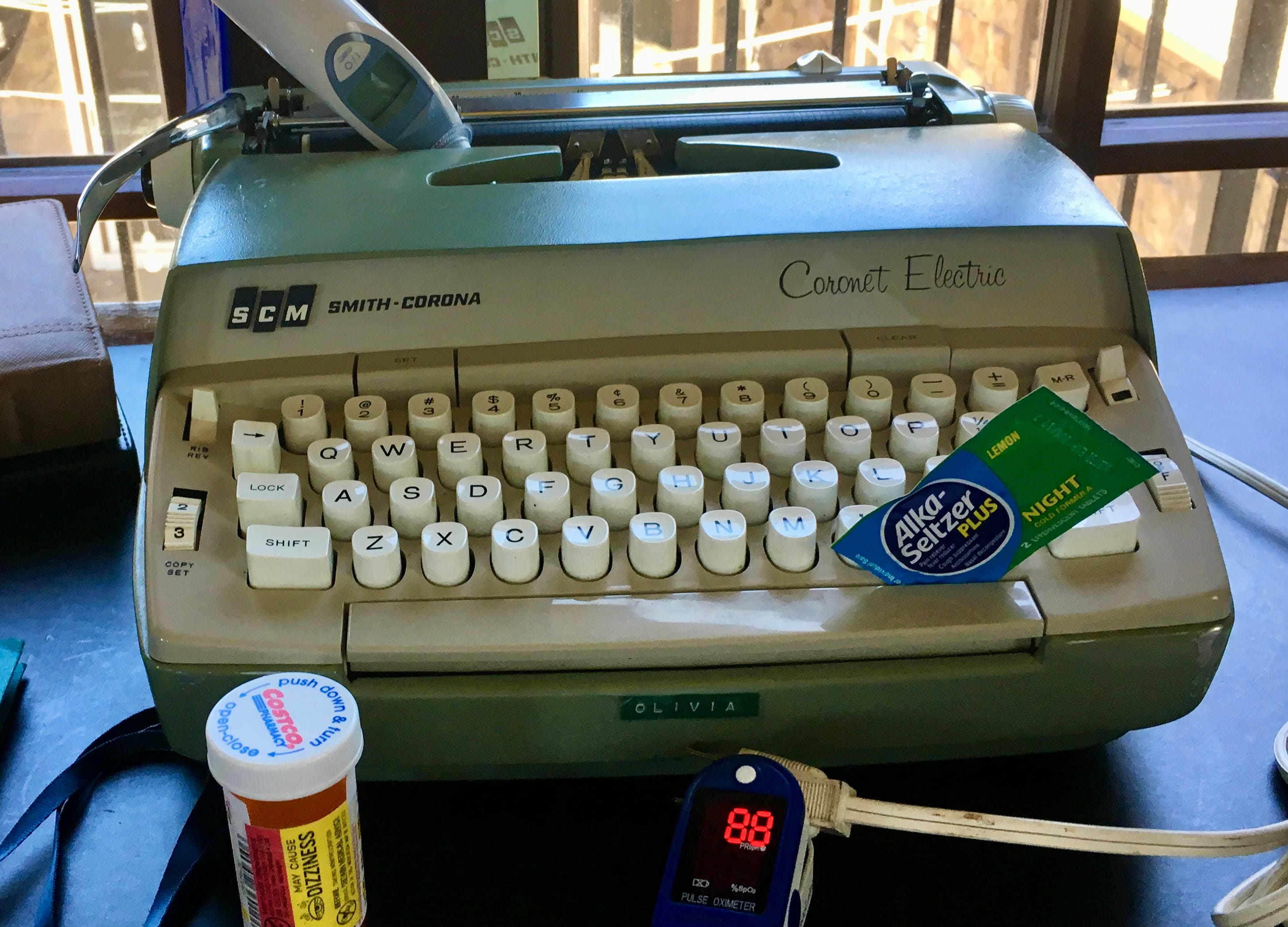
My latest fixation is with the mother of this draft: a thirty-five-pound, Smith Corona Coronet electric typewriter that I discovered in a thrift shop a few weeks before my wife and I moved to Dallas.
She—not my wife—perched on a saloon-style barstool, her original carrying case resting at the stool's feet like a loyal pet. Her avocado-green exterior beckoned from across the room, an irresistible siren's song. A sheet of typing paper crookedly curled around her platen, like a velvet evening gown slipping from one shoulder.
A turn of her roller revealed a nonsensical sprawl, flkasdjf;lksdjfaslkldkfhhf, as though she'd tipped back one too many. Beneath her ample space bar, a forest-green label with white embossed letters whispered her name: "Olivia."
Though her past may have included a few trysts with abandoned romance novels, I couldn’t resist making my move. I plugged her in and turned her on. She responded with a soft, sultry hum.
Olivia shivered with the lightest touch of my fingertips. “The quick brown fox jumps over the lazy dog,” I typed, each hammer snapping against the paper in a rhythmic pulse that felt almost... intimate.
Taking Olivia home
Olivia and I went home together, and I bought her a brand-new black-and-red spool ribbon.
Explaining Olivia's arrival to my wife during our downsizing effort preceding our move was another story.
“How could you?” my wife lamented. “We’re getting rid of everything. And you bring home a… a relic?”
“I’ll take care of her. I promise.” I did my best not to look guilty.
My wife just stared.
“It was just a one-time thing,” I struggled to meet her eyes. “She means nothing to me. Thirty-five dollars. That’s less than a dinner out.”
“Fine,” she finally said, flashing a smile and playfully rolling her eyes. “But when was the last time you took me to dinner?”
Eventually, my wife came to accept our little ménage à trois, and Olivia’s noisy presence became just another part of the family dynamic.
Our relationship
My relationship with Olivia isn’t without challenges. Her hammers can jam at the most inconvenient times, and her mechanical indifference to writer’s block is aggravating. I sometimes wonder if she’s secretly amused by my frustrations, her idling motor mocking me like a flashing cursor on a blank computer screen. But when we get into a groove and the rhythm from the slap of her keys takes hold, the words slide and glide like Carmen and Cugie on Hollywood floors.
Who says, “They don’t dance like Carman no more?”
I’ve read that only pretentious writers still use typewriters. On the opposite end of the cynic spectrum, Hemingway would probably have said electric typewriters are for wussies. Papa never met Olivia. He hammered out his last book, The Dangerous Summer on an old Halda—a Swedish manual. I like to think Hemingway would’ve been a little more laid-back if he’d spent some time dancing with Olivia.
Wandering Eye
In pursuit of One Life well lived, your Humble Correspondent favors what works, and so far, my relationship with Olivia has been productive. But lately, I’ve been flirting with a sleek Royal Epoch, a caseless, manual typewriter, slimmer, younger, and lighter than Olivia with no baggage. Perfect for hitting the road and keeping things low-maintenance.
Guys can be such pigs.
Olivia is now a welcome addition!