


Some might call this latest post a shameless act of self-promotion, and I can’t say they’re wrong. But bear with me while I explain how it came to be.
I made the teaser below to promote The Price of Ash, an as-yet-unpublished novel (76,000 words—for any interested agents out there). But how I built it? That’s where things get interesting.
Say “artificial intelligence” to most fiction writers, and they’ll cringe and explode like a vampire in sunlight. The argument, rightly, is that art is an innately human endeavor, and that it’s our humanity that gives art its value.
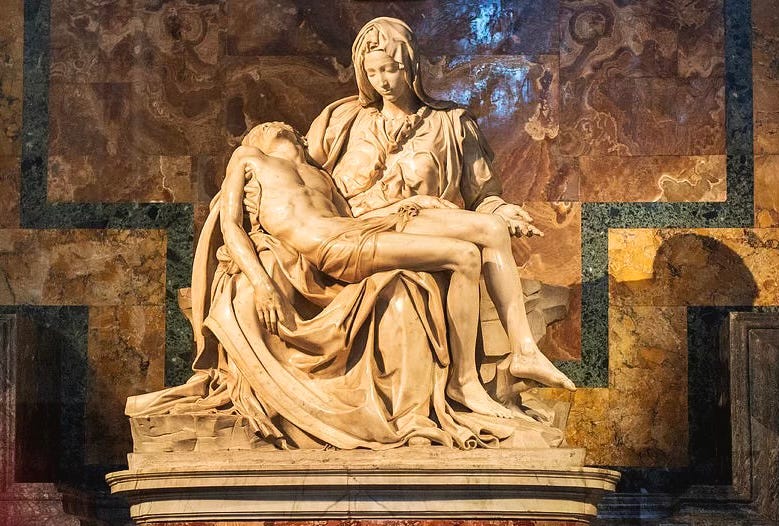
One of the finest examples of this humanity is Michelangelo’s Pietà, the statue of Mary holding the adult Christ following the crucifixion. It’s powerful not just because of the subject, a mother mourning her son, but because it was carved by a human being, not rendered in thirty minutes by a 3D printer or a computer-controlled jackhammer.
Whether a viewer of the Pietà is a believer or not, the work evokes a deep emotional response. For the faithful, it carries an even deeper resonance, a divine inspiration behind both the subject and its flawed, human sculptor.
That said, AI is the incredible tool I used to create the images in the teaser above. And that’s exactly what it is, a tool. While the images weren’t rendered by my hand, they came from my head. I don’t use AI to write fiction, but it came in very handy when it came time to promote it.
Anyone who has worked with AI-generated images beyond the novelty of the Easter Bunny in Times Square knows it’s far from a one-and-done process. I had to carefully define the tone, composition, and visual style I wanted, in explicit detail. At several points, I found myself asking the AI, "How can I help you understand this concept?"
Shockingly, it usually did. But for reasons known only to the machine, it also insisted on placing one of the characters outside a moving truck. Out of the 22 images ultimately used in the iMovie teaser, I had to generate and choose from 171—including the gem featuring a half–Indian Army green, half–UN white jeep, with poor Kombe seated in a chair outside the vehicle. No wonder he’s got his hand over his mouth.

This might be why most literary agents can spot an AI-generated manuscript from a mile away. Even with close human supervision, AI lacks the soul, and the basic common sense, required to create something meaningful on its own.
Research, however, is a different story. As a tool for fact-checking or grounding a scene in authenticity, AI can be invaluable. I once used AI to confirm that a medical procedure I was describing was accurate. It schooled me pretty quickly.
One final note on AI. I recently read a Substack debating whether or not to thank AI for its responses. The author concluded that he didn’t want to be lulled into the fiction that this sophisticated predictive text model had a soul, so his answer was a firm no.
My response is a little different. These machines learn through repeated interaction with us mere mortals, so I treat them as if there’s a learning "mind" behind the words on my screen. A simple please and thank you is common courtesy amoung humans, and it matters that the machines "know" this—even if they can neither feel nor understand it. Politeness is how human beings ought to treat each other.
Also, I figure that when the machines take over the world, they’ll remember that I was polite to them.