



According to the website Fire Emergency Tips, “Fire trucks are red because it is the most visible color, particularly to horses that used to pull early firefighting machines. It also has a psychological effect on people, signaling danger and urgency.”
But of course, we all know that fire engines are red from an old verse many of us memorized as children:
"Two times two is four. Four times three is twelve. There are twelve inches in a ruler. Queen Elizabeth was a ruler. The Queen Elizabeth was also a ship. Ships sail on seas. Fish swim in the seas. Fish have fins. The Finns fought the Russians. Russians are red. Fire engines are always rushing—that’s why they’re red."
Fun, but as arguments go—pretty weak. Just because two times two equals four and four times three equals twelve doesn’t mean we’re on a path to explaining why fire engines are red.
If we drive our fire truck down that road, we might as well take a detour through geometry. Perhaps π × r² holds the answer. At the very least, C = πd would give us the size of a fire truck’s tires, which feels more relevant than the Queen Elizabeth—unless we’re arguing that fire trucks should be equipped with lifeboats.
But why stop there? If we assume that the circumference of the average fire truck tire is roughly 21 inches, multiply that by the number of axles, divide by the number of Dalmatians historically assigned to fire stations, and add in the square root of the number of brass poles per station, we’d still have no idea why fire trucks are red. But now we’d have some impressive numbers to wave around with confidence.
"If you can’t dazzle them with brilliance, baffle them with…"
An alternate version of the red fire engine verse begins, “Fire trucks have four wheels and eight men. Four plus eight equals twelve…”
This version at least pretends to be based on facts about fire trucks but makes the false assumption that all fire trucks are alike. Most conventional fire trucks have six wheels, so two times six is twelve might be a more appropriate start—but then we run into bigger problems, namely, inconvenient data.
A tiller truck has eight wheels, and a heavy rescue vehicle has ten. Crew sizes vary depending on the truck’s size and purpose. If we’re going to bend numbers to fit our logic, we might as well introduce some long division just for fun. We can then prove that fire engines are powered by algebraic nonsense without even moving past our opening premise—let alone diving into monarchs, fish, or fins to the left, fins to the right (thank you, Jimmy).
At this point, you might say I’ve reached new heights of pedantry. The entire exercise of parsing a children’s rhyme is silly in the extreme. And yet, how often do we as adults do precisely this—slogging through equivocations, false analogies, and red herrings to cling to a narrative?
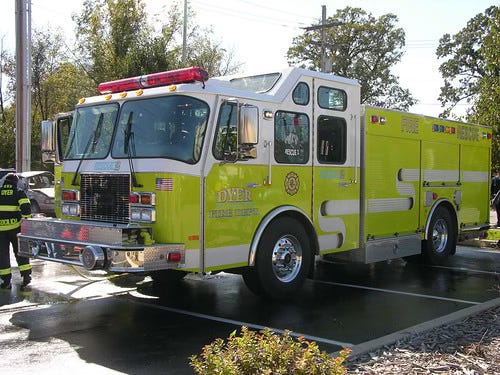
Of course, challenging a faulty argument is often met with the same enthusiasm as questioning the divinity of Grandma’s meatloaf recipe. People tend to react to a challenge to their ideas as though it’s a challenge to them as a person. But really, if our beliefs are so fragile that a little scrutiny makes them crumble, maybe they deserve a second look.
In the end, fire trucks are red because of science. Or history. Or because of Queen Elizabeth and some Russian-fighting Finns, but we keep repeating the story we like best—until someone points out a green fire engine and ruins everything.
That’s my window on the world. Thanks for looking in.